October 6th. Assad begins his retaliatory attack against the Syrian rebels in Idlib following the Homs drone strike at the Homs Military Academy – killing 125 and leaving 277 injured.
To many, Assad’s retaliation is a continuation of a consistent back and forth between the rebels and Assad, yet the recent bombardment of Idlib paints a different story.
Idlib and its surrounding regions, including Southern Aleppo, have suffered from air strikes by Assad, the Syrian Arab Army, and their Russian allies since the inception of the Syrian revolution. This current conflict is distinct chiefly by the scale of Assad’s airstrikes, its exceptional brutality, and its discriminatory nature.
The destruction of Idlib following Assad’s approval of military action has been nothing short of catastrophic – with the use of weapons banned by the UN via the Convention on Certain Conventional Weapons.
The conflict in Palestine-Israel rages on, yet it is only one of several theatres vital to the making of the current Middle East. With the bombing of Golan Heights – an internationally recognised Syrian territory occupied by Israel by Assad’s allied forces – Syrian involvement in the wider region is confirmed.
The purpose of this brief article is to record the intensity of Assad’s attacks against the peoples of Idlib and Northern Aleppo and to ascertain the damage to Islamist rebels and civilians.
As of October 11th, an estimated 45 civilians have been killed because of Assad’s strikes. The recorded number of civilians is expected to rise dramatically. Hospitals are overwhelmed, and Assad has targeted medical services. The lack of coordination by local authorities overwhelmed with consistent missile strikes further adds to a general inability to accurately.
The use of the 9M225 Missile has been rampant. This missile contains incendiary munitions which indiscriminately attack combatants and civilians. They have been recorded to have been used in the cities of Darat Azza and Atareb, the town of Al-Abzamo (West of Aleppo) and Jisr Al-Shugur (West of Idlib)
The use of internationally banned cluster munitions has been recorded to have killed civilians: Ahmed Abdo Taha Amouri, a non-combatant, succumbed to his wounds in the town of Termain.
Likewise, a boy, Muhammed Imad Qaraneiyah, succumbed to wounds sustained by artillery strikes targeted at the city of Jericho.
Residential areas in the town of Abzimo were similarly targeted by a missile bombardment, leading to mass displacement and many injuries.
Casualties in villages seem to be lower – with 1 civilian injured in Kafarhaya and another civilian being wounded in the village of Marayan. This is owing to the lower density of villages and smaller towns.
Hospitals have also been a target of attack, with the women’s and family health centre in Sarmin being out of service after being targeted by missile strikes twice on the same day. The number of casualties has been described as very large according to the Syrian Civil Defence (Live Helmets), but a more accurate number has yet to be provided.
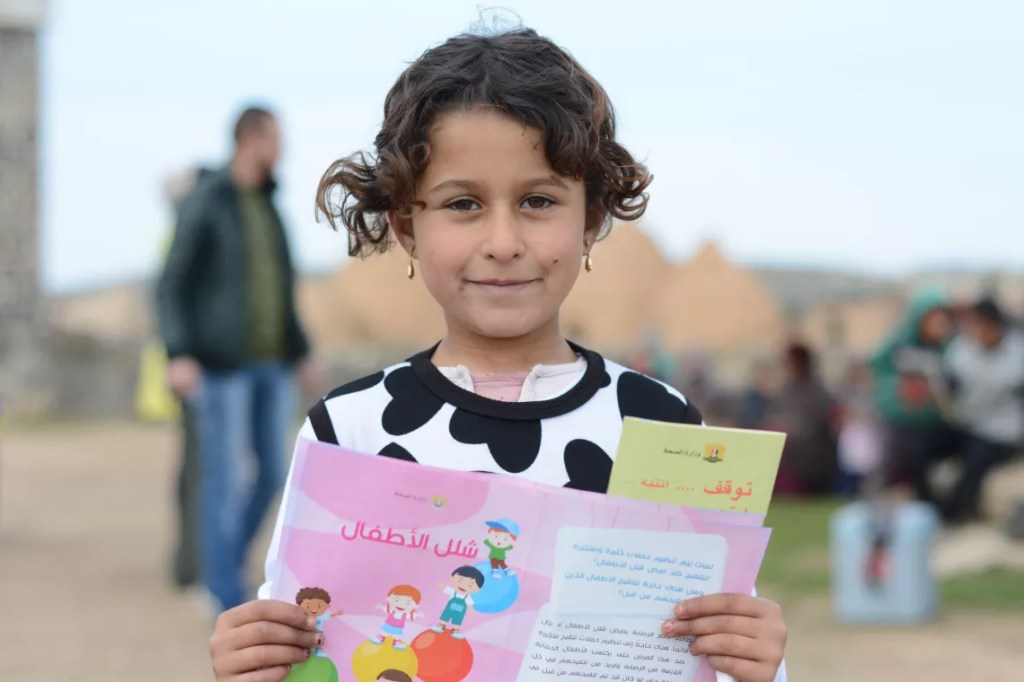
The mass displacement has overloaded refugee camps in the north of Idlib. An anecdote by two sisters is as follows:
“We left all our notebooks and toys. We didn’t feel like taking anything from them. The bombing and the sound were very strong. We were very afraid. The fire was strong at night and there were houses bombed. There was a lot of fear for us at my door.” Abeer and Reem are two sisters, the bitterness of bombing and displacement leaves a clear imprint on their faces, after the bombing by regime forces on the city of Binnish in the countryside of Idlib , forced them to leave their home, landing in Abu Dafna camp in the town of Killi, north of Idlib.”
A barrage of rockets has hit the town of Kafr-Taal – west of Aleppo, Sarmin – east of Idlib and Joseph in Idlib countryside. The number of casualties is yet to be confirmed. Hayat Tahrir Al-Sham (HTS) has posted videos of its militants firing small-scale artillery as retaliation, but released videos on their website have been relatively small as of October 11th.
The use of illegal white phosphorus bombs has been captured in the town of Abzimos in the countryside of Aleppo, with dozens of civilians wounded.
Phosphorus bombs have also been used in the city of Darat-Izza in the countryside of Aleppo.
Likewise, hospitals such as the Ibn Sina Hospital have been targeted by Assad’s rockets in Idlib, making the reported wounded count more likely to be added to the deceased count.
The intentional targeting of residential centres in Idlib constitutes a war crime and has led to scores of civilian deaths. At least two children were killed, with many injured on October 8th. This number has only increased with a missile bombardment targeting a camp for displaced peoples in Idlib on the same day.
As of October 11th – a ceasefire was reached between Assad and the Syrian Salvation Government (SSG) and their umbrella military wing – Al-Fatah Al-Mubeen (FM). The targeted areas include 10 schools, 5 mosques, 5 medical facilities, 2 hospitals, 3 camps for the internally displaced and four central markets, according to Levant24. These numbers add up approximately with video footage on the ground taken by the White Helmets.
FM’s response has been successful in creating a ceasefire, yet consistent renaissance missions by Russian drones suggest that the conflict may heat up at any minute.
The bombing of Damascus and Aleppo airports by the IDF suggests that the ceasefire has been influenced by fear of Israeli incursions within Syria following the bombing of Golan Heights by Palestinian cells in Syria. It is yet to be substantiated whether this ceasefire will hold. Both Assad and Syrian rebel groups affirm their support for Hamas and the Palestinian resistance, suggesting that common ground could be found until the Palestinian conflict has ceased.
While all of these suggest that the ceasefire will most likely last, the volatility of Syria and the opportunistic nature of Assad can not be ignored, with Turkish support being tunnel-visioned to Syrian National Army units and Arab tribes combatting the Syrian Democratic Forces in the North-East of Syria (Rojova).
12/10/23 -Ghurkan-
 Ghurkan Investigative Notes
Leave a comment