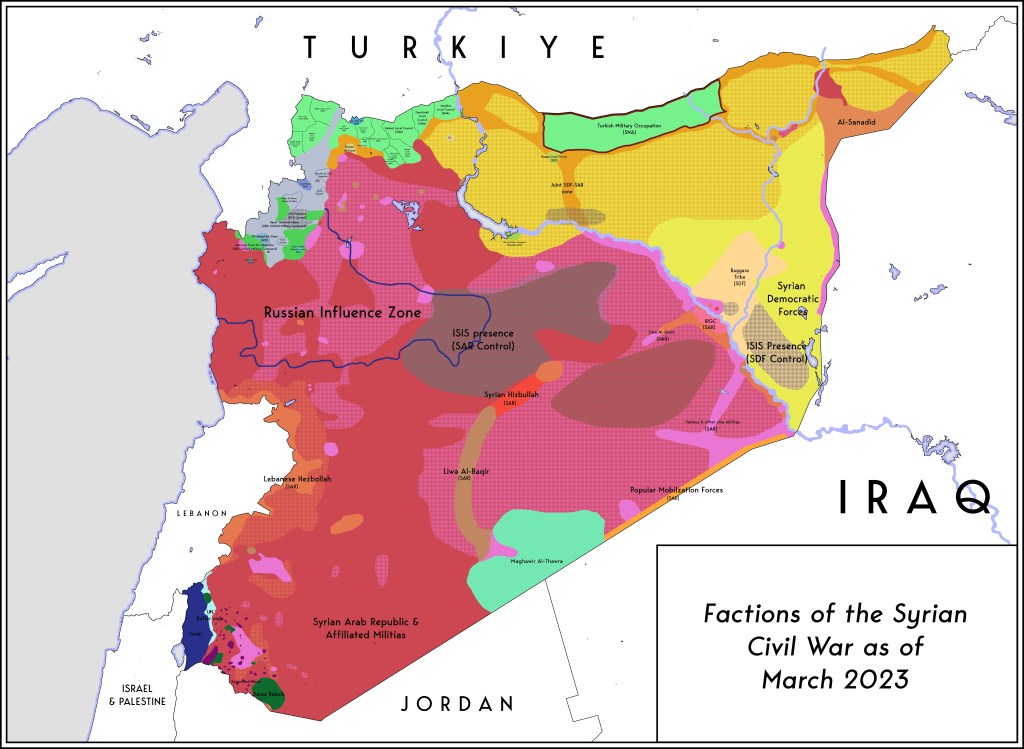
A brief timeline of events:
01/06/2023 – A suicide bombing in front of the General Directorate of Security building in Ankara. Two police officers injured. PKK claims responsibility.
05/06/2023 – The Turkish Armed Forces deploy troops and engages in aerial warfare against YPG – the Syrian branch of the PKK.
05/06/2023 – A series of drone attacks target a military academy ceremony in Homs – killing at least 100 opposition forces, wounding 240 and resulting in the deaths of both enemy combatants and innocents.
06/06/2023 – The SAA launches air raids and an invasion on Idlib after claiming that the responsibility of the drone attack lies with rebels in Idlib.
The situation in Syria has been one of shifting allegiances and intensity. The conflict remains stagnant, with different territories being firmly held by a mosaic of different parties with their own powerful backers acting as the various actors’ lifelines. Beginning on the 15th of March 2011, the war has spiralled into one of the longest standing conflicts in modern history – spanning 12 years with no foreseeable peace in sight. The conflict alternates between periods of high and low intensity among the various rebel groups, the Syrian Arab Army (SAA) and the Syrian Democratic Forces (SDF). This low intensity conflict reignited itself into all out war following the Ankara terrorist bombing conducted by the Kurdistan Worker’s Party (PKK). The PKK consists of a Syrian wing – The People’s Defense Unit (YPG) and has been described by commentators as being the group with the highest authority within the SDF and has significant backing from the US during their battles against ISIS as an ally to the US who maintains 900 soldiers deployed in SDF territories.
Turkish operations against the YPG first occurred in 2016 under Operation Euphrates Shield in Northern Syria. The president of Türkiye – Recep Tayyip Erdogan – cited the fear of a resurgence of PKK Kurdish separatist terror attacks in Türkiye. Operation Euphrates Shield culminated in a ground invasion and was the first step in incorporating various rebel groups under the umbrella term the Free Syrian Army (FSA, rebranded to the Syrian National Army) into a valuable ally for the Turkish armed forces. It is important to note that not all rebel groups aligned themselves completely with Türkiye. Many independent Jihadist groups such as Hayat Tahrir As-Sham (HTS), Ahrar As-Sham, and foreign groups such as the Turkestan Independence Party (TIP), Ajnad al-Kafkaz (A Chechen group, now migrated to Ukraine) reside and have control over majority of the Idlib governate, from where they launch independent attacks against the SAA, albeit with a shaky alliance with the SNA and respecting Turkish authority.
While the role of Türkiye is central to our understanding of why the conflict in Syria has resurged, we must not ignore the large role that Russia and Iran have played. Russian intervention in Syria began on September of 2015 under the pretext of fighting terrorist groups such as ISIS and HTS (Then Jabhat Al-Nusra). Russia provided Assad with much needed air support and made use of weapons such as cluster bombs and barrel bombs – two weapons banned by the Convention on Cluster Munitions due to the indiscriminatory nature in attacking both enemy militants and civilians. Iran has similarly helped Assad through funds, weapons, and providing volunteer soldiers such as Hezbollah in Lebanon and Shi’a Hazara militias from Afghanistan.
We can group the the opposing groups into four blocs:
1 Bashar Al-Assad. The President of Syria and the commander of the SSA who retains control of most of Syria except the Idlib governate, the northern Aleppo governate and the Kurdish region in the Northeast known as Rojava. He is backed by Russia and Iran
2. The SDF. An umbrella group lead by the YPG. It controls Rojava and conflicts with the Turkish government and therefore the SNA. The SDF is backed by the US.
3. The SNA rebels. An umbrella group consisting of many rebel groups based in northern Aleppo. They are backed and protected by the Turkish armed forces and engage in conflicts against the YPG.
4. The Islamist groups within Idlib. The official government of Idlib is called the Syrian Salvation Government and consists of many native Syrian groups and foreign groups (commonly referred to as Muhajir). They are de facto led by HTS and its leader – Muhammed Julani. They have no substantial backers, but can rely on Turkish protection to some degree, and have received funding from Saudi Arabia and Qatar in the past.
To understand why the current conflict resurged, we must analyse the low intensity conflict beginning from the end of 2022 leading up to October 2023. Often, when Syria is mentioned, attention is tunnel visioned on Russia, Turkey, or the American role within Syria, yet these one-dimensional points of view ignores significant actors within Syria. Influential groups of interest which must be paid attention to are the Jihadist and Islamist groups in the Idlib governate, chiefly HTS under Julani who holds de facto control over all of Idlib, and the foreign fighters allied with them. The two most important foreign groups are the Turkestan Islamic Party (TIP) and Malhama Tactical (A Jihadi Private Military Corporation offering its elite services to rebels) and its affiliates and trainees. The former has played an active role in recent clashes between HTS and the SAA, and the latter has helped train HTS and its affiliates into a fighting force. It is important to note that while the contribution of Malhama tactical has had an observable effect on the efficiency and professionalism in HTS units, Malhama tactical influence has largely collapsed due to death of Abu Rafiq (Malhama’s founder and ex-leader) and his family caused by a Russian airstrike.
Starting from the 2nd of December 2022, a series of clashes broke out along the Idlib de-escalation zone – an area where clashes between HTS and the SAA are frequent. The nature of these clashes is important in understanding the recent Homs drone attack. HTS and other affiliated groups such as the TIP and certain Islamist brigades in the SNA such Ahrar al-Sham and Suqour Al-Sham carried out a series of sniper attacks, martyr missions and armed clashes against the SAA and members of the Hezbollah forces. In particular, the Russian retaliation against Islamist rebels plays an important part in the course of these clashes. On the 5th of August – three civilians were murdered in a Russian airstrike. On the 25th of June, Russian aircraft killed three HTS fighters, injured 30 and murdered six civilians in the Idlib region. These clashes have continued to the present day and are marked by an unexpected proficiency and a positive ratio in which HTS forces neutralise SAA forces. Approximately 130 HTS affiliated casualties have been recorded, while approximately 360 SAA affiliated have been killed by HTS and its affiliates. These clashes have highlighted the HTS’ capabilities of construction and utilization of drones against SAA affiliated forces. On the 24th of June, a HTS drone targeted the town of Deir Shamil. Majority of HTS affiliated successful troops clashes have been recorded and uploaded by HTS with high quality video footage and professional editing – allowing for an accurate recording of casualties and confirmation of clashes. These videos are uploaded on social media such as twitter and telegram allowing easy access for fellow reporters and analysts.
It is with this background that we view the events of the 5th of October. There is ample evidence to show that HTS can launch drone strikes in Assad held territory – causing the SAA to engage in an increased bombing campaign in Idlib, with a high number of reported civilian casualties, and Assad bombing Idlib and the Aleppo countryside for 36 hours straight.
On the north-eastern front, Turkiye has engaged in significant drone attacks of their own. The peculiarity of this new offensive by Turkiye is its explicit and admitted goal in attacking critical infrastructure in YPG territory. Oil pipelines, gas, and electricity have all been valid targets for the Turkish forces. The newfound intensity of Turkish attacks is punctuated by the US shooting down a Turkish drone – an extremely rare NATO vs NATO clash. This rare event has been publicly marked as a misunderstanding by the US and has seen no further diplomatic or military retaliation from President Erdogan.
In conclusion, the current events in Syria are not unusual or random. They are the natural evolution of clashes between HTS and the SAA, marked by the gradual increase of drone warfare by HTS. The dedication and focus from Russia on the Ukrainian front has not completely deterred consistent and reliable air strikes from their side, yet it is evident that the war in Ukraine has lessened Russian ability to help the SAA as much as it had done from 2015 onwards. The increased competency of HTS and its affiliates in field clashes and drone warfare are something that must be taken into account, yet the migration of certain groups such Ajnad Al-Kavkaz into Ukraine must also be considered, due to a slight decrease in manpower and efficient and well-trained Chechen soldiers.
Likewise, conflict between the SDF and the Turkish armed forces have been endemic but limited to off-hand drone strikes by the Turkish armed forces. The US and NATO are heavily reliant on Turkish support in the war against Ukraine due to Turkish control over the Bosporus straights and the black sea, and the US and Turkeys diplomatic response over the downing of a Turkish drone by US armed forces seem to provide evidence that the US does not explicitly and unilaterally oppose Türkiye’s offensive against the SDF. Regardless, President Erdogans bombing of oil fields protected by the US armed forces may foreshadow lingering conflict between the two NATO allies in Syria.
The consistent and reliable use of drones have been pre-eminent in the Syrian conflict. Drones have been successfuly utilised by rebel groups not affiliated with a national military, their influence must not be ignored and should be researched in further detail. Russian intervention has increased in capabality due to its experience combatting suicide drones utilized by the Ukrainian armed forces in the Russo-Ukrainian war, providing another edge to the SAA.
While it seems that this conflict may last longer and be bloodier than previous conflicts following the general stabilisation of lines of control post-2016, there are several factors and actors which may unfold unpredictably. Chief among these unpredictable actors are HTS and other Jihadist groups affiliated with them. Exceptional attention must be given to these said actors, as they hold a large stake in the affairs of Syria.
–Zen Ghurkan (06/10/2023)
 Ghurkan Investigative Notes
Leave a comment