The impacts of the genocide in Gaza in its impact on solidarity is monumental globally. The concept of solidarity and its manifestations are often discussed from a Western background. The images and videos of university encampments through America, spreading to the UK and Canada are fresh in people’s minds. Hundreds of protests with hundreds of thousands of protesters remain an issue for Western governments obedient to Israel through their consistent diplomatic support and weapon sales. Solidarity with Gaza has been observed through the actions of nation states in the Global South. South Africa, for example, has filed an extensive case via the ICC and ICJ in an attempt to prove through international law that Israel has committed genocidal acts. A sorely shunned gauging of solidarity with relatively little analysis is solidarity for Gazans by various groups in the Islamic world, in some cases of regions where loyalty to Gaza and the Palestinians might be portrayed as irrational. The purpose of this article is to lay out the foundations for the importance of Islamic solidarity for Palestinians, Gazans and resistance groups like Hamas, a solidarity that does not wane regardless of ruling political units and their geopolitical alliances. The key focus will be on this article will be the case of Idlib.
Idlib is a relatively independent region in Northwest Syria. Following the events of the 2011 Syrian revolution, a large number of revolutionaries, largely made of Islamist groups, made their base in Idlib, owing to the successful sieges of the Assad regime in major cities and towns held by the Syrian rebels. Homs, Dar’a, Aleppo, previously bastions of resistance have been pacified by the Assad regime following months of debilitating, indiscriminate bombing and the use of starvation as a weapon of war. A mass of refugees from these cities made their way to Idlib through agreements with the regime. Idlib’s proximity to Turkey has been a great factor in deterring aggression from Assad, along with its natural defensible terrain. The environment in the Idlib governate is dominated by the importance of Islam in everyday life, from society to education and governance.
To accurately portray the perceived irrationality behind Idlib’s solidarity for Gazans and Hamas, it is necessary to provide a brief outline of the Syrian revolution and its actors. On the one side, there is Bashar Al-Assad, the president of Syria. Assad has staunch alliances with Russia, Iran and Iranian affiliated proxies. These include Hizballah and foreign fighter militant groups funded and supported by Iran. Liwa Fatemiyun is an Afghan Shia militia consisting of mostly the Hazara ethnic group, while Liwa Zainebiyoun is a Pakistani Shia militia consisting of mostly Pashtun Shias from the region of Parachinar. On the other, there are the Syrian Rebels inhabiting the North and split into two main factions. The first are the rebels ruling Idlib under the group Hayat Tahrir Al-Sham (HTS), headed by Abu Muhammed Al-Joulani. The second is the Syrian National Army which exists as a Turkish proxy in North Syria, East of Idlib. Both have faced indiscriminate attacks by Assad, Russia, Iran, and its allied proxies. Hamas, the leading party in Gaza is in an alliance with Hizballah, Iran, and has mended ties with Assad after previously supporting the Syrian Revolutionaries diplomatically and militarily. Members of Al-Qassam brigades, the armed wing of Hamas had actively joined the rebels, with many others sharing tunnelling tactics. It therefore seems rational for the people of Idlib to harbour negative feelings towards Hamas for their alliance with political actors that have carpet bombed, tortured, starved, massacred and raped hundreds and thousands of Syrians, a massive portion with no relation with any rebel groups.
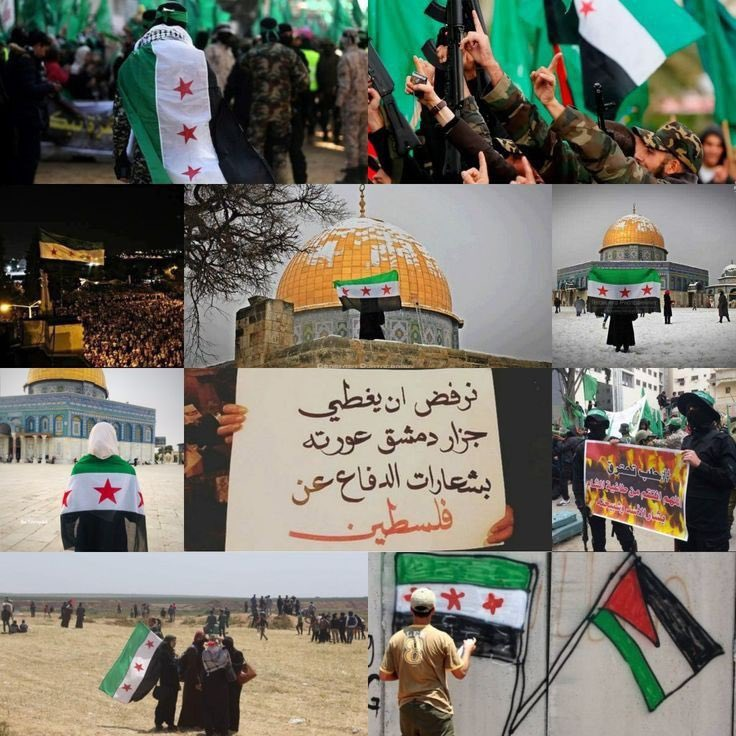
The actions of the people of Idlib and the statements of various political groups who harbour a deep hatred for Assad, Hizballah and other Iranian linked groups paints a rather different story. Rebel groups, chiefly HTS the ruling group in Idlib have expressed outright solidarity for both the Gazans and their political leaders that work with the enemies of HTS. On 19/10/2024, 3 days after the killing of Hamas chairman and leader Yahya Sinwar, HTS released a statement sending their condolences. Ahrar Al-Sham, another prominent Islamist group present in Idlib and SNA territories also sent condolences, showing the Palestinian flag alongside the flag of the Free Syrians.
Solidarity with Gazans is more observable through society and cultural events in Idlib. The annual Idlib Book Fair of 2024 had Gaza and Palestine as a central theme. Palestinian books written by historians, religious scholars, activists and poets were put in the limelight. The Palestinian flag was raised next to the Free Syrian flag. Public rallies and demonstrations were a common sight, with both flags hoisted alongside each other. Video documentaries and social media interviews were recorded asking residents of Idlib their opinions on the situation in Gaza and the Palestinian resistance. An often-cited reason for their support of the people of Gaza is their perception that their brothers in Gaza shared a similar history with the people of Idlib. Both have been carpet bombed without a care for civilians. Civilian infrastructure and residential buildings were actively targeted, and the justification for resistance was staunchly Islamic in both cases. The sanctity of the Al-Aqsa Mosque was also a vital reason for Idlib’s support of the Palestinian people.
Gazan solidarity with Syrian revolutionaries and their political groups has been pronounced. Both civilians and members of the Al-Qassam brigade have and continue to show solidarity with the people of Idlib, their resistance, and the revolution. Multiple members of Al-Qassam have travelled to Syria to fight alongside the rebels. Abu Umar, known fondly as “the Palestinian” was one such case. Abu Umar went to Syria in 2016 and fought against Pro-Assad forces in the 2016 siege of Aleppo. He was recently killed in an Israeli air strike following October 7. An unnamed trainer of Al-Qassam made his way into Gaza, citing the Qur’anic verses pertaining to the necessity of helping the Muslim “Ummah” (broadly translated as the Muslim Nation). Members of Al-Qassam have held public demonstrations in support of the Rebels, waving the Free Syrian flag, and occasionally the flags of political Islamic groups such as Ahrar Al-Sham. Ahmad Jabari, also known as Abu Mohammed, was a senior leader and second-in-command of the Al-Qassam brigades famously draped the Free Syrian flag over his car. Numerous murals in Gaza have been painted uniting the Free Syrian flag with the Palestinian flag. The phrase “Aleppo is bleeding” had been prominent during the 2016 siege of Aleppo. Multiple members of Al-Qassam have publicly posted on social media cursing Bashar Al-Assad.
Solidarity is not confined to the military wing of Hamas. Ismail Haniyeh, the previous chairman of Hamas political office prior to his death has publicly given speeches in support of the Syrian rebels, famously holding the Free Syrian flag. Khaled Mishal, the 2nd Chairman of the Hamas political bureau has been adamant in his support for the Syrian rebels being forced to eventually leave Syria for his stance on the Syrian revolution. As a result of these actions, Assad has condemned Hamas as traitorous on Syrian state TV. Hamas’s eventual reconciliation with Assad has evidently not caused a massive rift between the people of Idlib, their resistance, and the people of Gaza and their resistance. This is evidenced by a recent picture uploaded by an Al-Qassam fighter during the ongoing genocide draping his AK-47 with a flag of HTS.
The supposedly irrational is often rational. The people of Idlib view Russia, Assad and Iran as enemy, while the people of Gaza view Israel, America and the West as their enemies. Hamas, while engaging in pragmatic diplomacy, has not betrayed the spirit of the Syrian people, and this is most evident through its armed wing – Al Qassam. HTS, while engaging in pragmatic diplomacy and actively fighting against Hizballah and Iran, has not betrayed the spirit of the Palestinian people, and this is most evident in its public sympathy towards Hamas and the Palestinians along with the environment in Idlib which has encouraged acts of solidarity with the people of Gaza. In the context of Idlib and Gaza, with the rule of Julani and Sinwar, the prevailing sentiment is as follows:
“Under different circumstances, we would be fighting side by side, brother with brother, protecting our women and children, protecting our faith and mosques, fighting for our homelands, tied together with bloodied rope matted with the blood of martyrs who fought for freedom and dignity. We stand with you with our hearts until the time comes when we can stand together as brothers, prostrating together to our God in Al-Aqsa and declaring war on oppression. From your brother under siege in Idlib, to my brother under siege in Gaza.”
20/11/2024 – Ghurkan
 Ghurkan Investigative Notes
Leave a comment